965A
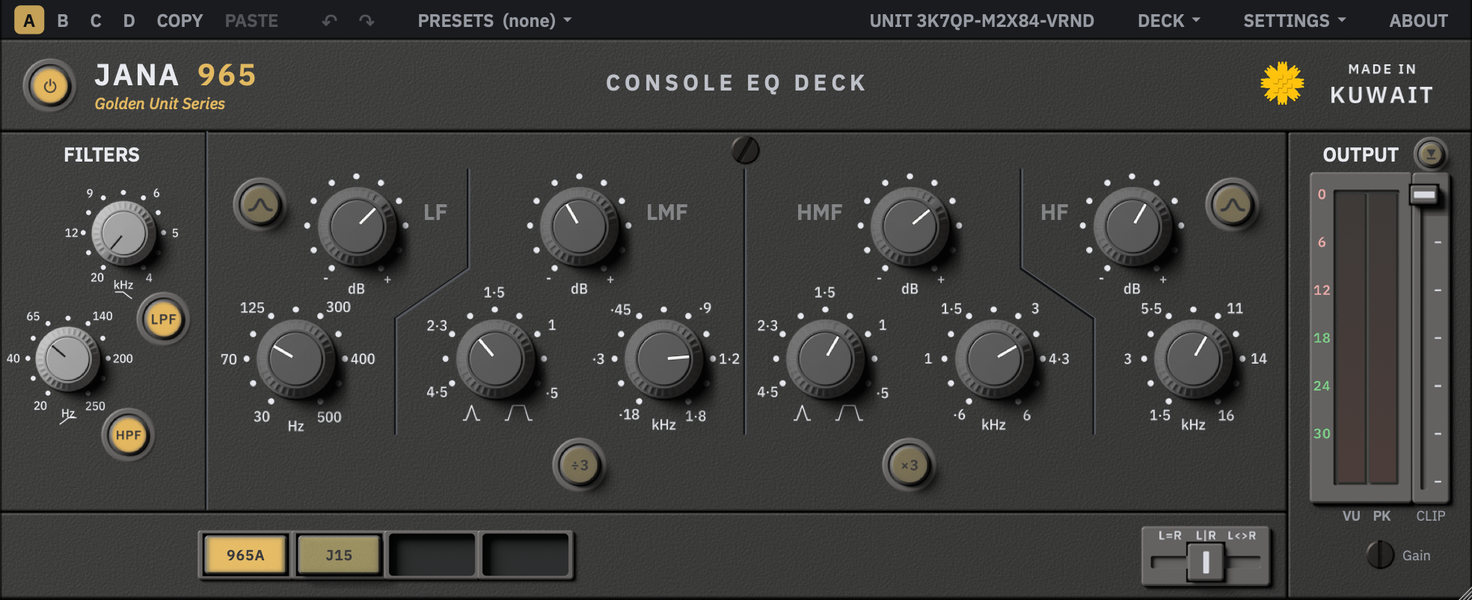
A stock card for the Jana 965, included with every copy. A circuit model, solved part by part.
Broad strokes. The 965A is a four-band parametric equaliser whose bells stay wide on small moves and tighten as you push, with a shelf and a filter at each end. Reach for it to shape the tone of a whole sound, rather than to fix one note in it.
It is our own design. We drew its circuit ourselves, out of parts we could order, on real supply rails, and modelled it end to end, part by part, through our own circuit-to-digital toolchain. It runs at zero latency, at the host's own rate.
| Card | 965A |
|---|---|
| Deck | Jana 965 |
| Kind | Circuit model |
| Comes with | The Jana 965, as a stock card: in the trial and in every licence |
| Price | Included in the Jana 965 ($59 at release) |
| Availability | Announced, not yet released. Release date to be announced. |
| Formats | Planned for version 1.0: macOS (VST3, AU and AAX) and Windows (VST3 and AAX) |
| Latency | Zero |
| System requirements | The Jana 965’s: see its facts |
Good for
- Broad tonal shaping, on a track, a bus or a full mix. A small move is a wide one. At ±2.4 dB, a mid band with Q at 1.5 is 2.49 octaves wide between its half-gain points, and with Q at its broadest it is more than five.
- Bigger moves that keep to their place. Push a band and it tightens: the same band at ±15 dB is 2.04 octaves wide.
- The top and the bottom. LF and HF open as gentle shelves, for lifting or trimming either end of a sound.
- Cleaning up. A high-pass from 20 to 250 Hz and a low-pass from 4 to 20 kHz, both 12 dB per octave: rumble under a voice, fizz on top of a guitar.
- Finding a problem, then cutting it. Boost and cut are mirror images. Sweep a boost to find a trouble spot, turn it into a cut, and the cut is the same curve upside down.
Less suited to narrow notches. Its narrowest bell is about a third of an octave wide at full cut, and wider at anything less. For a single ringing note, reach for the J15.
The controls
| Band | Frequency | Gain | Shape |
|---|---|---|---|
| LF | 30 – 500 Hz | ±15 dB | bell at Q 1.5, or shelf |
| LMF | 180 Hz – 1.8 kHz, ÷3 → 60 – 600 Hz | ±15 dB | bell, Q 0.5 – 4.5 |
| HMF | 600 Hz – 6 kHz, ×3 → 1.8 – 18 kHz | ±15 dB | bell, Q 0.5 – 4.5 |
| HF | 1.5 – 16 kHz | ±15 dB | bell at Q 1.0, or shelf |
| High-pass | 20 – 250 Hz | — | 12 dB/octave, Butterworth |
| Low-pass | 4 – 20 kHz | — | 12 dB/octave, Butterworth |
- GAIN boosts or cuts a band. Its centre is flat.
- FREQ sets where a band works: the bell's peak in bell mode, the shelf's half-gain point in shelf mode.
- Q on the two mid bands sets how narrow the bell is at full gain. The outer bells have a fixed Q.
- BELL / SHELF on the two outer bands changes the shape, and re-tunes the band so that the printed frequency stays true in both positions. A fresh 965A opens with both on shelf.
- ÷3 on the LMF and ×3 on the HMF move the band's whole range down or up by a factor of three, for the lowest lows and the highest highs.
- IN on each filter puts it in circuit. The four bands are always in circuit.
The output control, the clipper, the meter, VAR and the stereo modes are the frame's, the same on every card.
Its character
Broad, measured. At full boost, between the points 3 dB inside the peak, a mid band on the plugin runs from 2.55 octaves wide with Q at 0.5 to 0.32 of an octave with Q at 4.5. Its narrowest bell is nine to ten times as wide as the J15's narrowest.
The bells are proportional-Q: a small move is broad and a large move is focused. Measured on the plugin at about 1 kHz with Q at 1.5, a mid band set to ±2.4 dB is 2.49 octaves wide between its half-gain points, and the same band at ±15 dB is 2.04. The Q printed on the panel is the number a band reaches at maximum gain, so a band is never narrower than its legend.
Boost and cut are reciprocal. The cut curve is the mirror of the boost curve at the same setting: the measured peaks and dips below agree to the hundredth of a decibel.
One printed value, one meaning. A bell and a shelf built on the same cell are not centred on the same frequency; on this circuit the gap is about 2.8 octaves. So the BELL / SHELF switch also swaps the pair of capacitors that tunes the band, and the number on the panel is the bell's peak in bell mode and the shelf's half-gain point in shelf mode.
Built to be modelled with its tolerances. Every resistor and capacitor in the model carries the tolerance of the part we would buy, and VAR sets how far your unit strays from the ideal. At VAR 0 every 965A is the same ideal unit.
Frequency response
Each curve below is measured on the plugin itself: an impulse through the 965's release candidate at 48 kHz, offline, with the settings shown under each figure, and everything else at the card's defaults. Nothing in these figures is drawn by hand or taken from a design curve.
| Curve | Setting | Measured |
|---|---|---|
| LF | BELL, GAIN +15 dB, FREQ at 12 o'clock (200 Hz) | +15.08 dB at 200 Hz |
| LMF | GAIN +15 dB, FREQ at 12 o'clock (629 Hz), Q 1.5 | +15.08 dB at 629 Hz |
| HMF | GAIN +15 dB, FREQ at 12 o'clock (2.20 kHz), Q 1.5 | +15.06 dB at 2.20 kHz |
| HF | BELL, GAIN +15 dB, FREQ at 12 o'clock (7.99 kHz) | +15.09 dB at 8.02 kHz |
| Curve | Setting | Measured |
|---|---|---|
| +15 dB | LMF GAIN at its clockwise stop, FREQ 998 Hz, Q 1.5 | +15.07 dB at 998 Hz; 2.04 octaves between half-gain points |
| +7.6 dB | LMF GAIN at the dot for +7.6 dB | +7.64 dB at 998 Hz; 2.38 octaves between half-gain points |
| +2.4 dB | LMF GAIN at the dot for +2.4 dB | +2.39 dB at 998 Hz; 2.49 octaves between half-gain points |
| −2.4 dB | LMF GAIN at the dot for −2.4 dB | −2.39 dB at 998 Hz; 2.49 octaves between half-gain points |
| −7.6 dB | LMF GAIN at the dot for −7.6 dB | −7.64 dB at 998 Hz; 2.38 octaves between half-gain points |
| −15 dB | LMF GAIN at its counter-clockwise stop | −15.07 dB at 998 Hz; 2.04 octaves between half-gain points |
| Curve | Setting | Measured |
|---|---|---|
| LF bell | BELL, GAIN +15 dB, FREQ 101 Hz | +15.08 dB at 101 Hz |
| LF shelf | SHELF, GAIN +15 dB, FREQ 101 Hz | half-gain point 108 Hz |
| HF bell | BELL, GAIN +15 dB, FREQ 6.08 kHz | +15.07 dB at 6.12 kHz |
| HF shelf | SHELF, GAIN +15 dB, FREQ 6.08 kHz | half-gain point 5.34 kHz |
| Curve | Setting | Measured |
|---|---|---|
| HPF, ccw stop | HPF IN, FREQ at its counter-clockwise stop (20 Hz) | −3.01 dB at 20.0 Hz |
| HPF, 12 o'clock | HPF IN, FREQ at 12 o'clock (99 Hz) | −3 dB at 99.4 Hz |
| HPF, cw stop | HPF IN, FREQ at its clockwise stop (249 Hz) | −3 dB at 249 Hz |
| LPF, ccw stop | LPF IN, FREQ at its counter-clockwise stop (19.8 kHz) | −3 dB at 19.6 kHz |
| LPF, 12 o'clock | LPF IN, FREQ at 12 o'clock (7.00 kHz) | −3 dB at 6.98 kHz |
| LPF, cw stop | LPF IN, FREQ at its clockwise stop (4.00 kHz) | −3 dB at 4.00 kHz |
What it is modelled on
Its own circuit, and nothing else. The 965A is not a transcription of anyone else's unit and it carries no one else's name. The 965 in its name is reserved for our own designs; the cards we model from someone else's drawing take a J and a number instead.
Limits we state
- Small buffers at 96 kHz. At 96 kHz with 32-sample buffers, automating many 965A controls at once can run out of time in a buffer. Use 64 samples or more there; at 64 and above no buffer has been measured running out.
The Jana 965 page lists every stated limit, and the manual gives each one with its figures.
Price and ownership
The 965A is a stock card: it comes with the Jana 965, in the trial and in every licence, at no extra cost, and it ships inside the plugin. Cards beyond the two stock cards will be add-ons, each with a page like this one and its price on it.