Jana 965
JANA965
Announced · Release date to be announced
At a glance
- A console EQ deck. One frame, four card seats.
- Two cards included: the 965A (broad strokes) and the J15 (surgical).
- Zero latency.
- Formats: planned for macOS and Windows, as VST3, AU and AAX.
- Price: $59 at release, one price for everyone, free updates for life.
- Trial: from release, the trial is the whole plugin, with no time limit.
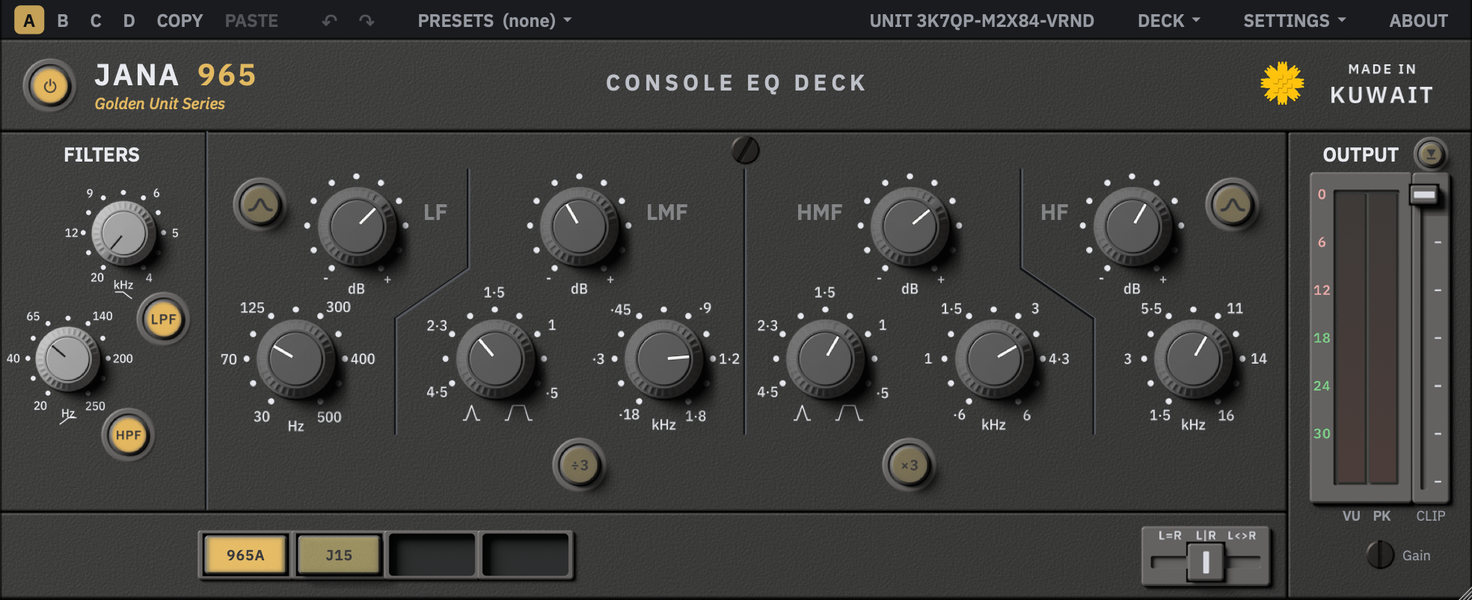
The Jana 965 is a console EQ deck: a frame with four seats for cards. The frame is the part that stays: the output stage, the meter, the stereo modes and the unit's tolerances. The card in circuit decides what the equaliser is, with its own circuit, its own controls and its own printed scales.
Two cards come with it: the 965A, our own design, and the J15 card for Jana 965. Both are circuit models, solved part by part, and the whole deck runs at zero latency. It is planned for macOS and Windows, as VST3, AU and AAX, and the trial will be the whole plugin, with no time limit. Each card has a page of its own.
| Product | Jana 965, a console EQ deck (an audio plugin) |
|---|---|
| Maker | Jana Audio, Kuwait |
| Availability | Announced, not yet released. Release date to be announced. |
| Cards included | 965A and J15 |
| Formats | Planned for version 1.0: macOS (VST3, AU and AAX) and Windows (VST3 and AAX) |
| Latency | Zero, on every card and at every sample rate |
| Sample rates | 44.1 to 192 kHz, mono and stereo |
| Price | $59 at release, with both stock cards. Not on sale yet. US dollars; local tax is added at checkout where it applies. |
| Trial | At release: the whole plugin, both cards, no time limit |
| Licence | Does not expire; no subscription; up to five computers per account |
| System requirements | A Mac with Apple silicon or Intel, or a 64-bit Windows PC with an Intel or AMD processor. Minimum system versions: to be confirmed at release. |
The deck
The row along the bottom of the panel is the deck: four seats, one card in circuit at a time. Click a seat to put its card in circuit. Deck setup puts cards into seats, moves them around and takes them out. The two stock cards fill two seats, and two are free.
Each card keeps its own settings. Switch from one card to another and the 965 keeps the settings of the card you left and brings back the settings of the card you open, or its defaults the first time. Nothing is carried from one card to the next, because a knob on one card does not mean the same thing on another. The frame's own controls (output, clipper, tolerance, stereo mode and readouts) stay where you left them.
A session remembers the card that was in circuit by name, not by seat, and it remembers both cards' settings. Rearranging the deck never changes what an old session sounds like.

The two cards
Two cards come with the Jana 965. They are different tools, and neither is the better one.
Which card?
| Property | 965A | J15 |
|---|---|---|
| Character | Broad strokes | Surgical |
| Reach for it to | shape the tone of a whole sound | fix one narrow thing in a sound: a ringing note, a hum, a whistle |
| Bands | Four, with a high-pass and a low-pass filter | Five, summed in parallel; no filter to set |
| Widest bell | 2.55 octaves | 1.5 octaves |
| Narrowest bell | 0.32 of an octave | 0.03 of an octave on bands 1 and 5, about 0.036 on bands 2 to 4 |
| A bell, as you turn the gain | Proportional-Q: a small move is broad, a large move is focused | Constant-Q: a small move is never broader than a large one |
| Gain, as the dial prints it | ±15 dB | −20 to +15 dB |
Bell widths are measured on the plugin itself: an impulse through the 965’s release candidate at 48 kHz, offline, VAR 0, read between the points 3 dB inside the peak or the dip at full boost or cut. The other rows are what each panel prints. Every figure is on its card’s page.
The 965A
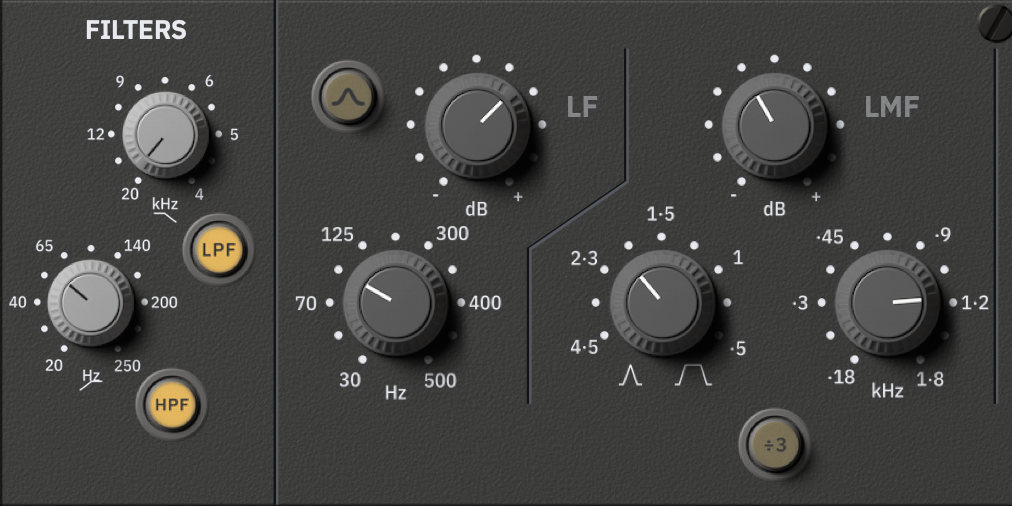
The 965A is a four-band parametric equaliser with a high-pass and a low-pass filter, and it is an original design. We drew the circuit ourselves, out of parts we could order, on real supply rails, and modelled it end to end through our own circuit-to-digital toolchain. It is not a transcription of anyone else's unit and it carries no one else's name. The 965 in its name is reserved for our own designs. More about the 965A, with its measured frequency response.
| Band | Frequency | Gain | Shape |
|---|---|---|---|
| LF | 30 – 500 Hz | ±15 dB | bell at Q 1.5, or shelf |
| LMF | 180 Hz – 1.8 kHz, ÷3 → 60 – 600 Hz | ±15 dB | bell, Q 0.5 – 4.5 |
| HMF | 600 Hz – 6 kHz, ×3 → 1.8 – 18 kHz | ±15 dB | bell, Q 0.5 – 4.5 |
| HF | 1.5 – 16 kHz | ±15 dB | bell at Q 1.0, or shelf |
| High-pass | 20 – 250 Hz | — | 12 dB/octave, Butterworth |
| Low-pass | 4 – 20 kHz | — | 12 dB/octave, Butterworth |
The four bands are always in circuit, and each filter has its own IN switch. Boost and cut are exactly reciprocal: the cut curve is the mirror of the boost curve at the same setting, to the last digit.
Figures are the ranges the panel prints, from the circuit design. Nothing here is a measurement of a shipped build.
What the bells do with gain
The bells are proportional-Q: a small move is broad and a large move is focused. At Q 1.5 a mid band set to ±3 dB is about two and a half octaves wide between its half-gain points, and the same band at ±15 dB is about two. Cut does the same, because the cut curve is the mirror of the boost curve.
That is the circuit rather than a setting. Boost and cut are a symmetric bridge with the same filter on both sides of it, and how wide the curve comes out follows from how hard that bridge is driven. Holding the width fixed instead would take a second control tracking the gain knob, which would make a band's Q error depend on where its gain is set. This is a unit built to be modelled with its tolerances, so we left that alone.
The Q printed on the panel is the number a band reaches at maximum gain. It is a bound: the band is never narrower than its legend.
One printed value, one meaning
A bell and a shelf built on the same cell are not centred on the same frequency. A unit that prints one number for both is telling the truth about one of them and something else about the other. On this circuit the gap is about 2.8 octaves.
So the mode switch does not only change the shape. It re-tunes the band, by swapping the pair of capacitors that set its frequency, so that the number on the panel is the bell's peak in bell mode and the shelf's half-gain point in shelf mode. It costs two more switch sections. It means the legend is true in both positions.
The J15 card for Jana 965
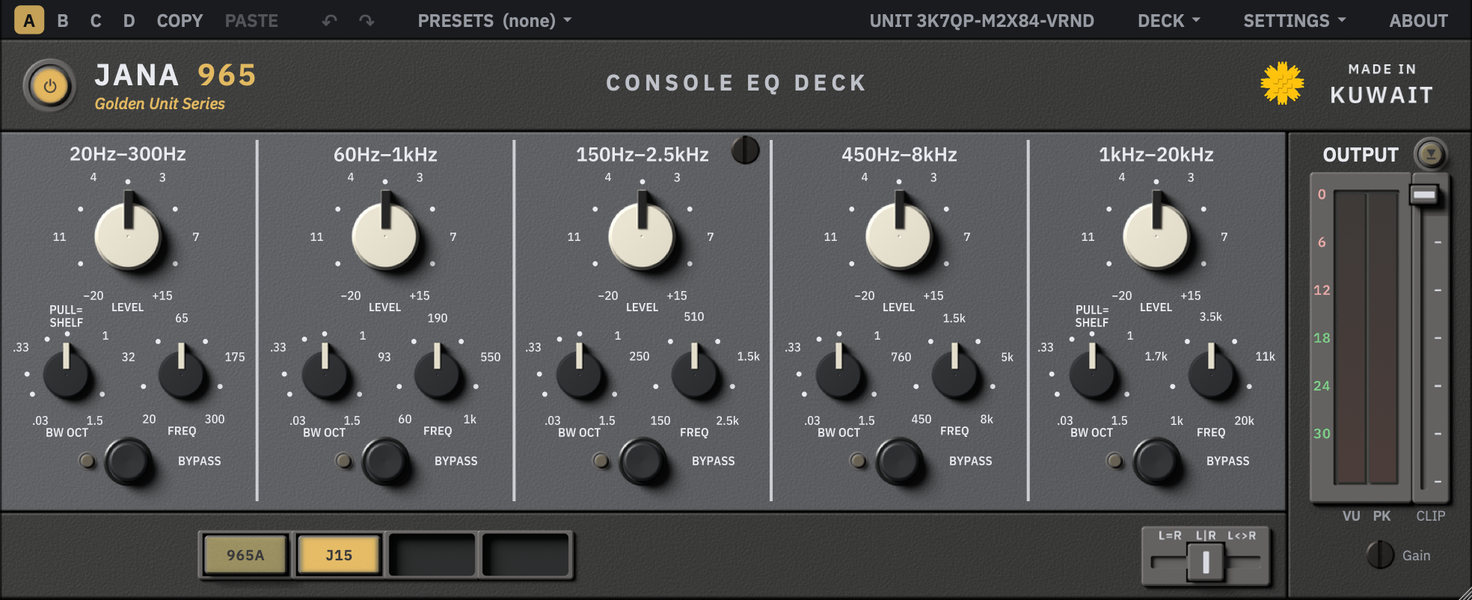
The J15 is modelled from the published schematic of a mid-1980s five-band parametric equaliser. Our claim is fidelity to that circuit as it is drawn, not to one measured unit of it. Its name follows our rule: 965 for our own designs, J and a number for the circuits we model from someone else's drawing. More about the J15, with its measured frequency response.
| Band | Frequency | Level | Bandwidth |
|---|---|---|---|
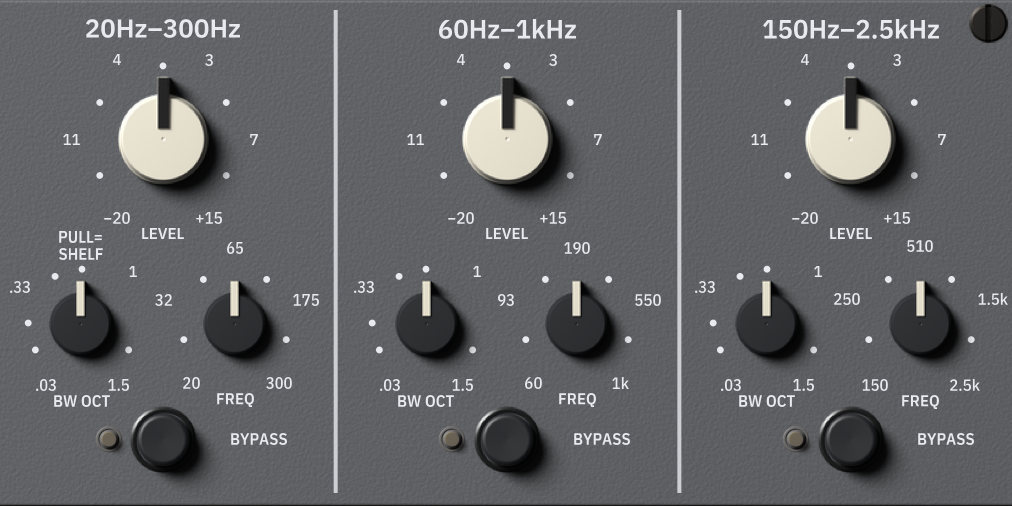
| 1 | 20 Hz – 300 Hz | −20 to +15 dB | 0.03 – 1.5 octaves, or shelf |
| 2 | 60 Hz – 1 kHz | −20 to +15 dB | 0.03 – 1.5 octaves |
| 3 | 150 Hz – 2.5 kHz | −20 to +15 dB | 0.03 – 1.5 octaves |
| 4 | 450 Hz – 8 kHz | −20 to +15 dB | 0.03 – 1.5 octaves |
| 5 | 1 kHz – 20 kHz | −20 to +15 dB | 0.03 – 1.5 octaves, or shelf |
Five bands, summed in parallel. Each band has its own frequency, bandwidth and level, and its own bypass. The outer two pull to shelf: option-click the bandwidth knob, or click the PULL=SHELF legend, which lights. There are no filters on this card. The output stage, the meter and the tolerances are the frame's, as on every card.
The dials print what the original prints. Its numerals, range titles and words are set in our own type, at the original's angles. Each pot's law is modelled, fitted through those printed numerals, and the readouts say what the model does at every setting.
Phase as well as magnitude. The bands are summed in parallel, and a sum depends on phase as much as on level, so the model follows the circuit's phase too, at zero latency and at the host's rate. Zero latency has a price at the top of the audio band, where several wide bands overlap: no filter without latency can follow the circuit's phase all the way there at 44.1 or 48 kHz. At those rates the model can differ from the circuit by up to 2.28 dB (44.1 kHz) and 2.11 dB (48 kHz) at the worst of over a thousand settings tested, and by 2.38 dB at one setting found by a deliberate search. Higher rates close the gap: 1.02 dB at 96 kHz, 0.48 dB at 192 kHz.
At rest, it is the circuit as drawn. With every level at zero the J15 plays the schematic's own rest path, including the infrasonic filter it draws at 15 Hz, which is 0.7 dB down at 20 Hz. VAR reaches those fixed parts too, so a drawn unit varies at rest as well.
The ranges are the ones the panel prints. Nothing here is a measurement of a shipped build.
The frame
The output stage. An output control trims ±12 dB after the card. After it comes a soft clipper for catching stray peaks. It is out unless you put it in, its ceiling is on a fader from 0 to −36 dBFS, and its lamp shows how hard it is working and is also its switch. A bargraph meter reads the output. The power switch takes the whole unit out, meter included.
Zero latency. No oversampling, no lookahead and no linear-phase filtering. Every card runs at the host's own rate, so the 965 adds no delay to the track it sits on.
Readouts. Any control can show its value on a plate beside it. Values are hidden until you ask for them with Show values. A plate shows what the panel prints; turn on Show realized values and it also shows what the model does at that setting. Your host sees the same choice as the parameter Readouts, set to Theoretical or Actual.
The usual tools. Four snapshots, A to D, copy and paste between them, undo and redo, and presets.
Tolerance, and unit-to-unit variation
Both stock cards are circuit models, and a circuit model is built from a parts list, not from a curve. Every resistor and capacitor in it carries the tolerance of the part we would actually buy, and parts bought as a matched set, like a dual-gang pot, a resistor network or a reel of one capacitor value, are modelled as a set, with their own matching, rather than as independent draws. That distinction matters: a set whose errors cancel is free, and a set whose errors add is where the spread really comes from.
VAR sets how far the unit strays from its ideal. At 0 it is the ideal. At 100 % every part sits within its rated tolerance, and the control goes on to 200 %, twice the rated spread. Turn it up and you are no longer using the ideal of the unit. You are using an instance of it: frequencies, bandwidths and gains each sitting a little off their legends, the way they would on any real front panel.
Every instance of the 965 you open is a different unit off the same line, and a session remembers the unit it was mixed on. At VAR 0 every unit is the same ideal one.
The stereo modes. A stereo pair can be drawn three ways, and the switch says which:
- L=R: one unit on both channels.
- L|R: two units that are mirror images about the ideal curve, so the pair's average is still the ideal. This is the default.
- L<>R: two units drawn independently.
Trying and buying
The Jana 965 is not released yet, so nothing in this section can be done today. This is how trying and buying will work from release.
The trial is the whole product. Before you buy, the Jana 965 and both cards run fully, with no time limit and nothing switched off. The sound, the readouts and the printed values are exactly an owner's: nothing you hear or read depends on the licence.
What the trial does not do is bring settings back. A session reopened on a 965 that is not yet bought opens at its defaults, with a short notice saying why, and presets and saved defaults do not save. Within a session everything works, snapshots and copy and paste included.
Your sessions are kept. The 965 always writes its settings into your session. Buy it, and every session you saved during the trial opens exactly as you left it. If the licence arrives while a session is open, the notice offers to load its settings, and nothing changes the sound until you press it.
What comes with the 965. Both stock cards: the 965A and the J15. Cards beyond these two, when there are any, will be add-ons. A card takes effect together with a 965 licence: bought on its own, it stays in trial until the 965 is yours. In a bought 965, a card you do not own plays fully, and only its own settings are not brought back.
Nothing extra to install. Every card ships inside the plugin, and buying a card adds it to your licence. A new card, when there is one, arrives with an ordinary update.
Activation. Automatic and online: press Buy in the plugin and pay in your browser, and the licence arrives by itself; on another computer, press Activate and sign in once. Automatic activation covers up to five computers per account, and you can deactivate a computer yourself, in the plugin or from your account page. The licence file from your purchase email is the backup: drag it onto the panel and it works offline, on a computer that is never online. The plugin goes online only when you press Buy, Activate, Check purchases or Deactivate. Starting it never touches the network, and a licence is checked on your own computer, with no expiry.
Updates. Every update is a download from the download page, installed over the one before. The plugin never checks for updates on its own.
Price
The Jana 965 will be $59 at release, with both stock cards, the 965A and the J15. Each add-on card will be $25, or $20 a card when you take three or more together, and will require the Jana 965 licence. Prices are in US dollars; local tax will be added at checkout where it applies.
One price for everyone. Everyone pays the same price at the same time, and we don't run countdown sales. When we make an offer, it is open to everyone.
What is included. The frame and both stock cards; the trial, before you pay, for as long as you like; activation on up to five computers, and the licence file for any computer that is never online. Free updates for life: every update to the 965 and to every card you own, on every platform we release it for, for as long as we make it.
Not on sale yet. The store opens when the Jana 965 is released.
No refunds for a change of mind. Try the full plugin free, for as long as you like, before you buy. We refund accidental duplicate purchases. Refund policy · Terms of sale and licence · Privacy
Formats and system requirements
Planned for version 1.0, and not final until it is released. macOS: VST3, AU and AAX. Windows: VST3 and AAX. One plugin for Apple silicon and Intel Macs, and zero latency in every format.
On Windows the 965 is a 64-bit plugin for Intel and AMD processors. Windows on Arm is not supported at this release.
In Pro Tools the 965 is a real-time AAX plugin. It is not offered for AudioSuite.
The system requirements are on the download page, and the installers and the manual will be there at release.
Limits we state
What the measurements found is stated here, not hidden. The manual gives each limit with its figures.
- Small buffers at 96 kHz. At 96 kHz with 32-sample buffers, automating many controls at once can run out of time in a buffer. Use 64 samples or more there; at 64 and above no buffer has been measured running out.
- The J15, heavily automated, playing live. With many J15 controls automated at once, a move can now and then take effect one buffer late while the session plays, so the playback differs briefly from a bounce of the same passage. An offline bounce is always exact, and two bounces are always identical.
- The J15's two lowest bands, swept narrow. Sweeping FREQ at the narrowest bandwidth, low in the band, gives a slightly different colour from the circuit's while the knob moves. It is not a burst, and the sound settles to the circuit's once the knob stops.
- The J15 at the top of the audio band. At 44.1 and 48 kHz the model can differ from the circuit where several wide bands overlap near 20 kHz. That is the price of zero latency, and the figures are in the J15 section above.
Want one email when the Jana 965 is released? Write to hello@janaaudio.com with the subject "Tell me at release". We keep your address only to send that one message, and we delete it once it is sent, or sooner if you ask. The privacy notice says the same.
Questions: hello@janaaudio.com.