Cards
A card is the part of a Jana deck that decides what the processor is: its circuit, its controls and its printed scales. The deck around it stays the same. On the Jana 965, our first deck, a card is a whole equaliser, and the frame keeps the output stage, the meter, the stereo modes and the unit's tolerances. The Jana 965 page explains that deck.
Each card has a page of its own: what it is, which kind of card it is, what its controls do, how it sounds, its frequency response measured on the plugin, and the limits we state for it. Cards are listed here under the deck they belong to.
Two kinds of card
Every card starts from a circuit, and there are two ways to build one.
A circuit model is one specific circuit, our own or one from a published schematic, solved part by part: each part is in the model with its value and its tolerance. Its ranges, its interactions and its quirks are the circuit's own, because they come from the parts.
A first-principles design is built by us from the mathematics of how a kind of circuit behaves, rather than from one unit's parts list. Because it is not tied to one unit's parts, its controls and ranges are ours to choose.
Neither is a lesser version of the other. Both kinds are measured on the plugin before they ship, and each card's page states its limits. Both stock cards are circuit models.
Cards for the Jana 965
The Jana 965 is a console EQ deck, and each of its cards is a whole equaliser. These two are its stock cards. Both come with the Jana 965, in every copy, trial included. They are different tools, and neither is the better one.
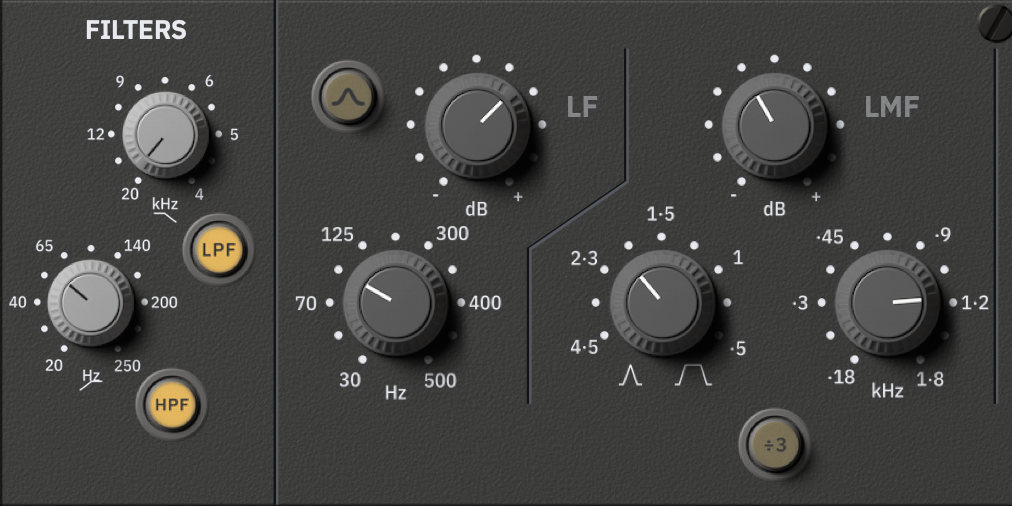
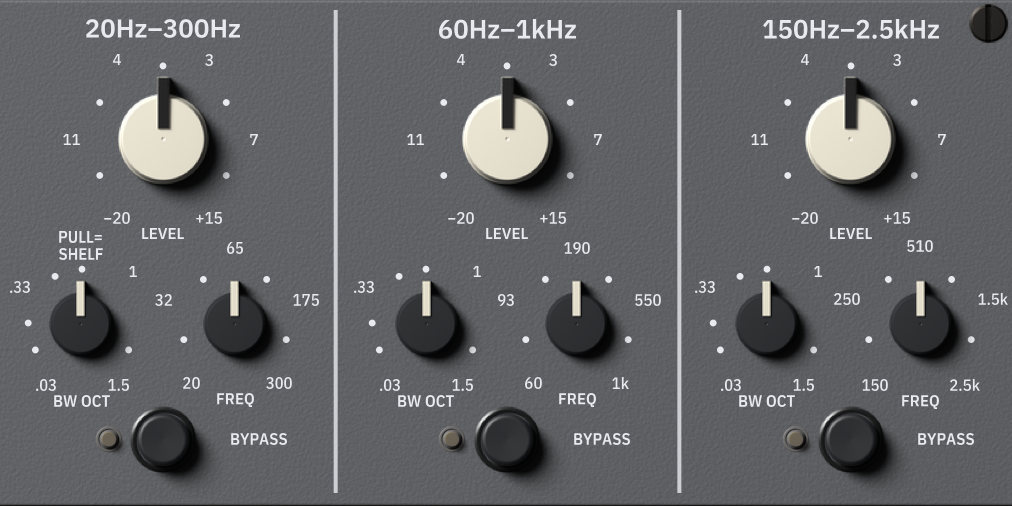
Which card?
| Property | 965A | J15 |
|---|---|---|
| Character | Broad strokes | Surgical |
| Reach for it to | shape the tone of a whole sound | fix one narrow thing in a sound: a ringing note, a hum, a whistle |
| Bands | Four, with a high-pass and a low-pass filter | Five, summed in parallel; no filter to set |
| Widest bell | 2.55 octaves | 1.5 octaves |
| Narrowest bell | 0.32 of an octave | 0.03 of an octave on bands 1 and 5, about 0.036 on bands 2 to 4 |
| A bell, as you turn the gain | Proportional-Q: a small move is broad, a large move is focused | Constant-Q: a small move is never broader than a large one |
| Gain, as the dial prints it | ±15 dB | −20 to +15 dB |
Bell widths are measured on the plugin itself: an impulse through the 965’s release candidate at 48 kHz, offline, VAR 0, read between the points 3 dB inside the peak or the dip at full boost or cut. The other rows are what each panel prints. Every figure is on its card’s page.
965A
A circuit model: our own four-band parametric with high- and low-pass filters, modelled part by part. An original Jana Audio design.
The J15 card for Jana 965
A circuit model: five bands summed in parallel, modelled from the published schematic of a mid-1980s five-band parametric equaliser.
Cards to come
Cards beyond these two, when there are any, will be add-ons, each with a page like these and its price on it. They take effect together with a Jana 965 licence, and they arrive with an ordinary update: every card ships inside the plugin.